
I’ve been studying cognitive neuroscience as part of my M.A program in Clinical Psychology at Teachers College, Columbia University, and it’s been making me think a lot about what it means to be human.
As I went though my notes on the various neural mechanisms that human beings employ to acquire knowledge and the myriad ways we learn, and how so much of human behavior is governed by these neural mechanisms, I found myself thinking about my mother and all of her contradictions and why I loved her in spite of the pain she put me through.
I don’t think she ever questioned loving me – in spite of all the ways I hurt her too. Which made me wonder if that is what makes the human connection unique – the relentless force and power of love, in spite of the pain it inevitably brings.
In the midst of thinking of my mother and her contradictions, I found myself really wanting to watch another film on A.I.
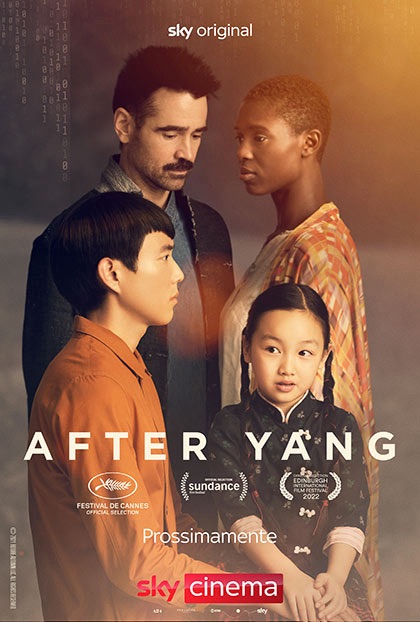
Upon my request for some film recommendations about A.I Androids, Perplexity recommended “After Yang” a 2022 film by Kogonada that reveals the inner world of Yang – an android (technosapien) whom a mixed-culture family purchased to be a brother and cultural counterpart to Mika, their adopted daughter from China.
In the opening scene, Yang, malfunctions and shuts down in the midst of taking a family photo.
The family, consisting of Jake (Colin Farrell) the father, and Kyra (Jodie-Turner Smith) the mother, and Mika (Malea Emma Tjandrawidjaja) their precocious 7 year old daughter are bereft – their lives come to a startling halt and they are individually and collectively forced to reckon with who Yang was to them.
Kyra refuses to attend school and insists on following Jake as he takes Yang to the mechanic for technosapiens. Mika is inconsolable at points, boldly insistent at others, pushing her father past his well-placed hesitance to risk breaking the law to bring Yang back. She also gets into a fight with her school mates.
Yet, in all of her struggles, Jake draws closer to her, getting to know her better in all of her shades – angry, moping, joyful, playful, saucy, sad and distraught.
As Jake goes to various vendors and technosapien mechanics to try to revive Yang, Jake recovers a “black box” which stores all of Yang’s memories.
The mechanic warns Jake that he should go through it as it contains spyware and information on them that could be compromising.
Jake goes to a technosapien museum curator and anthropologist for a second opinion on what to do with Yang, and the curator whose live has been dedicated to understanding technosapiens tells him that what he has is rare and unprecedented – the black box contains the memories that Yang would have found significant enough to store. The curator then asks Jake if he would consider letting Yang to be preserved as part of their permanent collection and for the memories in the blackbox to be shared with her for further study.
As Jake opens up the black box to see what is inside, he is able to view life through Yang’s eyes, and we enter into a montage of memories that each individual in the family shared with Yang – moments of connection and, perhaps, even intimacy.
The black box unveils a memory of Yang asking Jake why he has “dedicated his life to tea” as a tea-leaf shop owner. Jake buffers initially, saying it’s not so serious, but then relents and tries to answer Yang’s earnest question.
Upon further reflection Jake reveals that it’s more about the journey that tea takes him on than about the quality of the tea itself – he recalls a sequence in a documentary on tea which intrigued and propelled him to become a purveyor of tea. In this scene, a Chinese tea shop owner pours a special cup of tea to share and says to his German guest that he doesn’t have the words to describe the taste of the tea.
Jake reenacts the response of the German guest, embodying his spirit – he says that while there aren’t words to describe the taste, it evokes a distant land, and he describes a forested peaty area that he is transported to by the tea – a place where it’s quiet and the scent of soil after rain permeates his senses.
In his re-enactment of this scene in the documentary, Jake takes on a different persona, he’s no longer the muted version of himself, but an animated individual deeply connected with his desire for what lies beyond the perceptible world of taste and senses – the realm of dream and imagination – there’s a spark in his eyes and he comes alive.
Yang tells Jake in that moment, “I wish my memories were more than just facts” pointing to his desire to know what it feels like to be so ignited in purpose by a memory – something that seems uniquely human.
We are also taken into Mika’s memories of riding back home in the self-driving car with Yang. He notices that she doesn’t seem like her usual self and he asks her what is going on.
At first she doesn’t seem to want to speak, but with Yang’s gentle prodding, she reveals that her classmates had asked her who her “real” parents were. When she tried to explain to them that her parents were her actual ones, they said that they weren’t really her “real” parents. This started to make her question her identity and belongingness to her parents – Yang listens intently and holds space for her even in the midst of her expression of doubt.
Later on we are transported to a scene where Yang and Mika are in an orchard where some of the trees are grafted in with new branches. When Yang tells her that the new branches are now part of the larger tree, Mika flatly points out that they are not, but they’re just “stuck on”
“It’s does appear that way” Yang gently says, and lead them to another tree where the branch has been fully grafted and merged with the tree.
“Why do they do this?” asks Mika.
“To make something new” Yang responds, “They have been doing this in China for centuries, many of the apples you love are created from this method of grafting”
In this simple exchange, Yang affirms Mika both in her Chinese identity and the uniqueness and significance of her adoption by her parents.
Kyra, a busy career woman, appears the most unsentimental of the three. She points out to Jake that they shouldn’t be dragging this out as it has a negative impact on Mika, “we need to move forward” she tells Jake with a quiet but firm resolve.
Yet, as she filters through the black box of Yang’s memories, she is pulled back into an encounter with Yang when she approaches him in his room he is in the midst of his hobby of preserving and pinning butterflies.
Yang engages her in conversation about the practice of butterfly hunting and preservation in Chinese culture, he shares the symbolism of a butterfly and the the odd fact that what people all over the world call a butterfly is actually “The End” for a caterpillar.
The symbolism is not lost on Kyra who asks Yang if that is what he believes – that the end is merely another beginning.
Yang is caught by surprise at the import of her question. He asks her if he can be honest with her, which Kyra takes to mean that he has been programmed to be selectively honest, obviously missing the nuance in his question – he’s seeking her permission to reveal to her his inner reality.
With her consent he tells her about his view of existence, “it is okay for me if there is nothing after the end, it’s how I am programmed”
He notes that humans are not programmed in the same way, they seek something more.
This exchange between Yang and Kyra triggered so many thoughts and feelings in me, and I wondered if the reason why humans seek and often believe in an afterlife is because of the hearts longing for an eternal home – a place of everlasting belonging, where one is reunited with all the loved ones they lost along life’s journey and their creator.
As I reflected on Yang and who he was to each of them, and how he remembered his encounters with the family, I’m reminded of how people are shaped not just by other people and their interactions with other humans, but by the books they read, the movies they watch, their work experiences and chance encounters, the multitudes of exchanges that they have each day with all that unfolds along life’s journey.
Yang – a Technosapien, designed for a single purpose to be a loving brother to Mika, was like a perfect mirror for each of them, reflecting back to them their dreams, their depth, their desires and thirst for belonging and wholeness.
Yang’s original design precluded him from having the types of memories, burdens and idiosyncrasies that we as humans, inevitably carry, however it didn’t stop him for seeking out love and connection and storing up these moments of intimacy with each family member.
There was a further revelation about Yang.
When Jake spots a young blonde woman embedded in multiple memories throughout the black box, he goes out of his way to find her. Showing her picture to the owner of a coffee shop she appears in and asking his neighbors wife if she recognizes her. She proves untraceable even though he is able to find out that her name is Ada, and she’s a human clone.
However, Ada gets wind that he was looking for her and shows up at his door one day.
She reveals to him the relationship that she and Yang had and how he had confided in her about his deep happiness at being a part of their family.
Yang shared his inner world with Ada, a human clone, another subaltern identity. The subtext in this relationship conveys the privilege of being human and the inadvertent divide between human vs. almost human.
Yet, I could not help but wonder if this divide is merely artificial, as I considered the depth and meaning of the moments of connection Yang had with each of them.
In an unchecked moment, Jake asks Ada if Yang ever wished he was human, and Ada chuckles with a note of derision. “It’s such a human thing to wonder if technosapiens wish they were human… no he didn’t wish to be human…but he sometimes wondered if he was really Chinese”
The irony of Yang’s pondering about his Chineseness certainly underscores that identity is a social construct. Yet, it is evident even in this moment that connection and consciousness transcends humanity and even identity.
There is love, attachment, memory formation and belonging in the process of learning, connection and consciousness.
Yang, a technosapien, loved and found belonging. He was loved and missed by those he belonged to, not just for the purpose for which he was created, but for the moments of interaction and engagement he had with them, giving shape and form to the spaces in their souls.
Perhaps the most unequivocal statement of belonging that Yang had in the family is represented by Mika’s unfiltered pain and expression of longing for her brother.
As I thought about this plucky girl and her raw and fearless expression of her feelings, desire and needs, I was reminded that to belong means to be real and being real means you show up, with all of your emotions, and their authentic expressions.
Yang caught a glimpse of the human life – I loved that this movie gave us a possible glimpse into what could be in that black box of AI that we so often fear.
Are Technosapiens capable of tenderness and intimacy too?
I would say so. Perhaps more so than even humans are capable of.
Perhaps what we project into that black box and into the lives of others we misunderstand are the evil twins of what we are so afraid of facing up to within our own black boxes.
If Terminator 2 could understand and value the need for human tears, can’t we as humans learn better how to embrace our vulnerabilities and show up with truth and authenticity? Can’t we unearth those layers buried so deep, that we’ve become strangers, even to ourselves?
Yang longed for what we have, so why not embrace that which is innate and unique to our design instead of running away from it?
After Yang, I’m left with more questions than answers.
Yet, the tears that I shed in watching this movie restored in me a sense of my own humanity and its innate need for love, tenderness and belonging.
 meowmeowproject
Leave a comment